
Self-Compassion: The Missing Piece
Self-Compassion : The Missing Piece. How to Go From Surviving to Thriving in Parenting
If you feel like you’re stuck in an endless cycle of trying to ‘do’ or ‘be’ better in your parenting - you read the books and do the breathing - but nothing is working then you’ve come to the right place. Read on for why you may be stuck in repetitive cycles. In this article we focus on why self-compassion is a crucial part of parenting and how dropping shame and guilt helps to deepen the sense of love and connection in your closest relationships.
Self-compassion and self-love are often seen as indulgences in parenting. But what if I told you that they are not optional but rather essential to parenting and parenting well? Parenting is demanding and asks a lot of us emotionally, relationally, and biologically. It is both an implicit skill and a learned skill, shaped not only by what we know, but by what we absorbed long before we could walk and talk.
Each of us carries an internal parenting blueprint, formed through our own experiences of being parented. Sometimes this blueprint supports secure, connected relationships. This is known as a ‘secure attachment’. As children, our needs for emotional security, comfort, exploration and to be seen and accepted for who we truly are were met. Research tells us that about 60% of the population falls into this category.
“The good news is we can learn to be in a secure attachment with others.”

Fig 1: Pixabay. Attachment is not fixed, it is a spectrum. You can be in a secure attachment in some parts of a relationship and insecure in others.
Sometimes this blueprint reflects a jumble of unmet needs from your primary caregiver, which could reflect the state of your family’s dynamics at the time, for example, parental stress (for many different reasons). This can lead to an ‘insecure attachment’; where our relationship style to our caregiver, family and subsequent romantic partnerships are characterised by:
anxiousness or stress at feeling abandoned in response to casual non-threatening interactions and feeling like you’re not ‘enough’
avoidant styles where you’re emotionally averse/phobic or fiercely independent
a mixed state where you cycle between both creating a ‘push-pull’ feeling between craving closeness and fearing it.
If this is you, you’re not alone, about 40% of people fall into this category. Secure and insecure attachments are not binary, but fall along a spectrum and certain attachment systems can be activated within different people and scenarios. The good news is we can learn to be in a secure attachment with others.
Alongside our inheritances, we also carry choice. This choice may contain a deep, embodied longing to parent differently to our ‘relationship blueprint’.
We can imagine and cultivate the relationship that we want with our children- a tender, respectful, personal one, anchored in mutual appreciation. Bridging the gap between how we were parented and how we want to parent begins not with our children but with ourselves.
And if you have an insecure attachment the first relationship that needs healing is the one with ourselves- this is where self love and compassion enters the conversation.
Why Love Can Feel Hard
Attachment research suggests that a little under half of adults were not consistently parented in ways that fostered secure connection. Many of us were raised in behaviour-focused, or ‘WEIRD’ (Western, Educated, Industrialised, Rich, Democratic) cultures, where compliance was enforced over emotional attunement. Attunement happens when we can tune into our kids or another person, to truly see, validate, understand and be ‘in sync’ with them. We can see the generalised lack of attunement with our kids in society with common phrases such as ‘children should be seen not heard’, ‘toughen up’, ‘tough love’, you’re a ‘good girl/boy’ (which as a child perceives things simply between two extremes, if you’re not ‘good’ you’re ‘bad’).
When our experience of love is that it is conditional or inconsistent, leaning into love as a parent can feel unsettling. Tenderness may bring anxiety. Presence may feel unfamiliar. Love can feel like a language we understand intellectually but struggle to speak fluently.
The nervous system prefers what is familiar even when it’s painful. Avoiding emotional discomfort is protective, but it can also keep us parenting from old patterns rather than conscious choice. It is not enough to know and want something intellectually when your body experiences it differently.
For these reasons it can seem a surprise that parenting doesn’t actually feel intuitive.
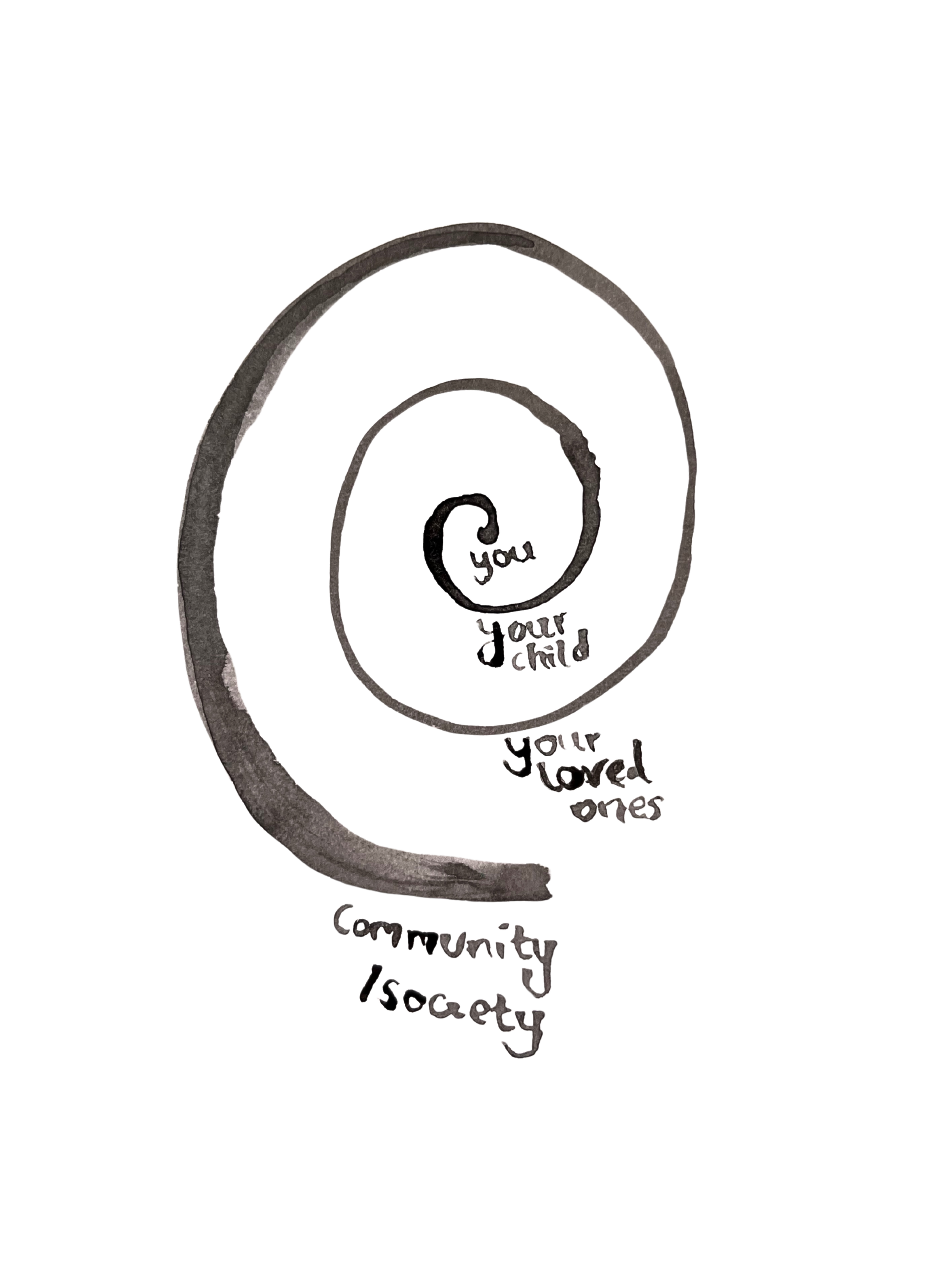
We must fill our own cup to fill our child’s, to then fill our partner’s, our loved one’s and our community’s
Fig 2: Macaulay, Spiral of self compassion: Starting Inwards and Spiraling Out. 2026
Love Blocked by Shame Cycles
To parent differently requires the capacity to sit with our emotions, our own and our child’s, without rushing to control or suppress them. For a variety of reasons, this may not have been available or safe for our primary caregivers to do. They did the best they could with the tools they had and so are you.
Compassion and love for our children starts with compassion and love for ourselves. To fill our child’s ‘cup’ we first must fill our own. Shame is actually considered a core emotion in relationship research literature. Being able to ‘be with’ shame, let it flow over us and leave us is essential to managing our own emotions, to our emotional intelligence and to be able to love ourselves. If we are stuck in shame cycles ‘I’m a failure’, ‘I’ll never be good enough’, ‘I’m unloveable’, ‘I’ve ruined my child’, these are real barriers to change.
“We end up being road blocked by shame.”
These negative cycles prevent us exploring our full emotional range, especially curiosity and joy, which are essential in parenting. We end up being road blocked by shame, it stops us from swinging back into balance with our child, from tuning into our kid because we’re hijacked by the shameful thoughts. Shame blocks us from being the confident, loving leader our kids need.
So let’s drop the shame and clear the road for a more in tune relationship with our child by offering ourselves compassion in place of these old, unhelpful stories. Remember it is never too late to repair our relationship with our child and to bring them back into the fold of unconditional positive regard. And we can do this for ourselves too.
What Do We Mean by Love?
Despite love sometimes feeling vague or sentimental, it is actually an active and intentional feeling. As a parent we know love is potent. It is a powerful change agent. There is a sense of reverence, tenderness and ‘unconditional-ness’ about it.
Psychiatrist M. Scott Peck defined love as “the will to extend oneself for the purpose of nurturing one’s own or another’s spiritual growth.” Love, in this sense, is a practice, a series of choices grounded in care
Compassion researcher Professor Kristin Neff describes compassion as the ability to be with suffering, supported by three elements:
Mindfulness - noticing what is present without judgment
Self-kindness - responding with warmth to ourselves rather than criticism
Common humanity - remembering we are not alone in our struggle
These capacities are foundational to building our ‘compassion muscle’ and our children’s and they can be learned.
“Mindfulness is the process of separating your true self from thoughts, labels or judgements”
How Self-Compassion Effects Our Children
Children don’t learn self-compassion because we tell them to be kind to themselves. Children learn self-compassion like any other skill, by watching how we treat ourselves- when we make mistakes, reach our limits, or feel overwhelmed. Children have an incredibly complex neural network that acts as an exquisite imitation system from birth and is activated in the early months of infancy. Imitating voice and behaviour is how they learn. ‘Do as I say and not as I do’ is unfortunately a ridiculously useless saying.
“When children witness self compassion they internalise a kinder internal voice.”
Self-compassion means becoming a safe place to rest within ourselves. It allows us to recognise our needs, set boundaries that protect our energy, and offer our children the best of us. We want to finish the day with some kind of reserve, not just giving our kids and ourselves the fumes of what’s left.
When children witness this, they internalise a practice of compassion. A kinder internal voice that supports them through mistakes, big feelings, and life’s inevitable challenges.
Self-Compassion as a Practice
The wonderful thing about patterns in parenting is that we have many opportunities to practice a new skill. The potent love we have for our children is a strong motivating force and has the potential to facilitate meaningful transformation we are wanting for ourselves.
Practicing self-compassion begins with being there for yourself, coming home to yourself. Learning a secure attachment involves turning inward rather than seeking what you need from others.
Start with mindfulness: gently noticing your internal voice.
When you catch self-criticism, pause and notice ‘ah there’s a thought’
Mindfulness is the process of separating your true self from these thoughts, labels or judgements. Starting this awareness or separation then enables us a choice in our self talk
Respond as you would to a dear friend with honesty and warmth
A reflective practice such as having someone to talk to, a journaling practice, or engaging a professional for help can help soften the inner critic
You might want to write the self-critical thought in one column and respond in the other with a compassionate reframe, for example:
“I’m a bad parent” → “I’m a good mother/father who is needing rest, support, nourishment, and care.”
“I’ve ruined my child” → “My child is perfect as they are, there is a lot right with my relationship, I can repair with my child, tomorrow is a new day”
“I’m unloveable” → “Love is my right for simply being born, I don’t need to earn love, I am loveable and I am learning how to be self-compassionate”

Fig 3. Macaulay, Start Here (Watercolour, 2026)
With repetition, this mindfulness process becomes more familiar and offering yourself compassion becomes more accessible and believable. Talking this compassionate voice out loud gives others, especially your children, a script to tell themselves when they make mistakes, have needs or reach their capacity.
Self-compassion is an essential part of being in a relationship. The relationship with ourselves, with our kids and with others. Our children develop their skill in self-compassion just like any other skill - by modelling themselves on us, the parents. Dropping shame and guilt can help clear the road to be more in sync with our kids and a more confident leader.
Parenting offers many loud and quiet invitations to live in alignment with our truest desires. As you nurture yourself, you nurture your children and their relationship blueprint, as the legacy you’re creating for your family.
____________________________
A Note from
The Lap | Love Apeiron
Thank you for showing up for your child.
If this article resonates, you’re warmly invited to join my weekly newsletter where we dive into reflecting on joy - designed to support parents in living and parenting with greater presence, curiosity, and ease.
I also offer parent coaching for those wanting support in unlearning old patterns as well as building relationships centred in connection and compassion.
You can explore more at thelap.com.au